
Fishing tIps
#002 How to choose the right spinning reel
Choosing a spinning reel can feel overwhelming at first. There are many sizes, gear ratios and technical terms, but the right reel is simply the one that matches how and what you fish. A good spinning reel makes casting smoother, improves line control and helps you fight fish with confidence. In this guide, we explain the most important things to look for when choosing a spinning reel, in a clear and practical way.
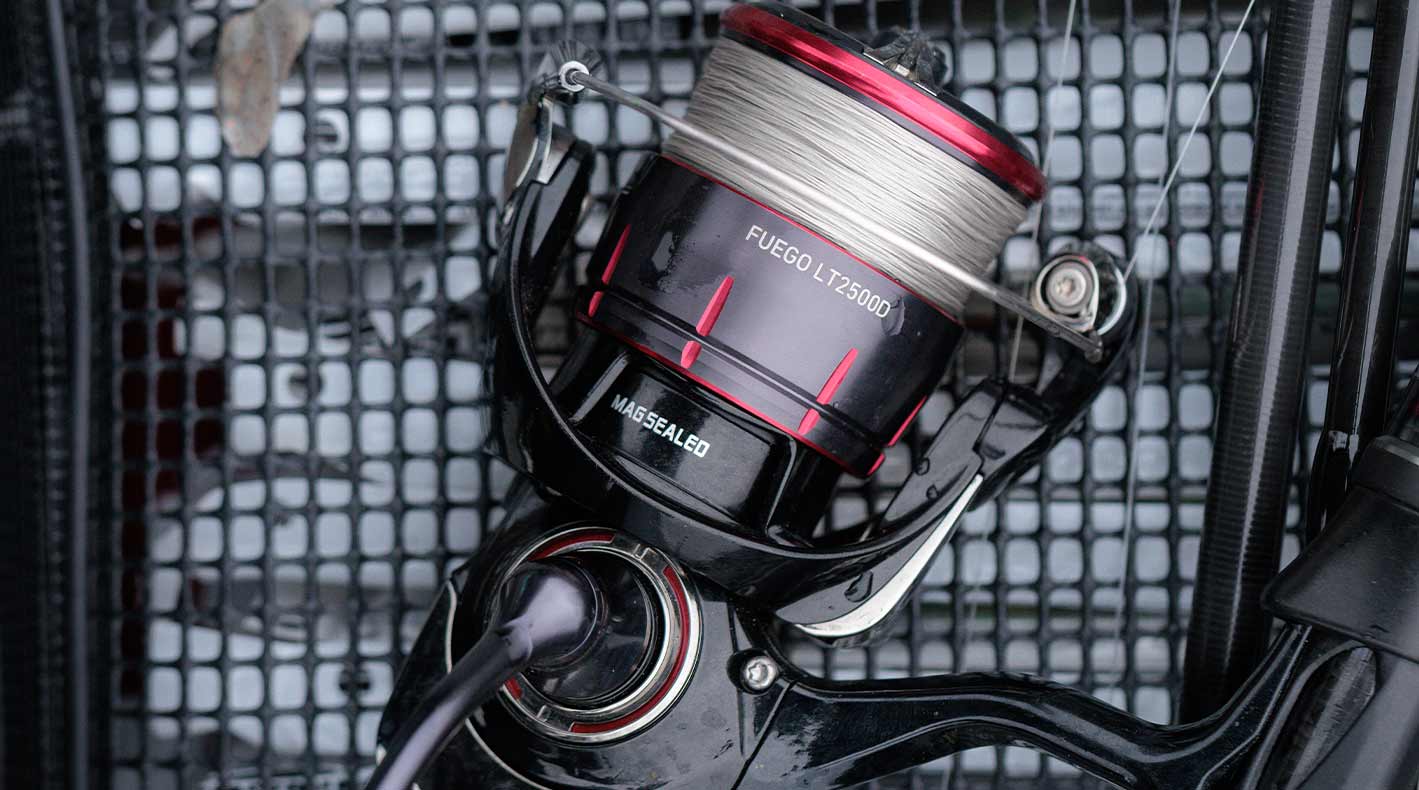
Spinning reel size explained
When choosing a spinning reel, size matters — and it’s one of the first decisions you should make. Reel sizes are usually given as numbers like 1000, 2500, 3000, 4000 and so on. The higher the number, the larger and stronger the reel, with more line capacity and drag power.
These numbers give you a good indication of how much line the reel holds and how it balances with different rod lengths and fishing situations.
Here’s a simple breakdown to help you choose the right reel size based on the type of fishing and species you’re targeting:
1000–2500: Ideal for light freshwater fishing, such as put & take, as well as trout, grayling and perch fishing. These smaller reels are perfect when fishing with lighter lures or bait and when comfort and balance are more important than raw power.
2500–3000: A versatile all-round size that works very well for coastal fishing, such as sea trout and sea bass. These reels offer a good balance between weight, line capacity and strength, making them comfortable for long sessions along the coast.
3000–4000: A solid choice for pike fishing, mainly because of the increased line capacity and stronger construction. Size 4000 is often preferred when fishing with larger lures or thicker line.
4000–8000 (saltwater models): These larger reels are built for serious saltwater fishing, such as targeting cod, pollock and halibut on trips to Norway. They are designed to handle heavy loads, deep water and long, powerful runs.
8000 and up: Reels in this size range are typically used for bluewater fishing, targeting large, hard-fighting species like giant trevally and other pelagic fish, where maximum line capacity and drag strength are essential.
Gear ratio explained
Gear ratio describes how many times the rotor spins around the spool for each turn of the handle. It is usually written as a number like 5.2:1, 6.2:1 or 7.1:1. The first number shows how many times the rotor spins around the spool per crank of the handle.
A lower gear ratio means the rotor spins fewer times per handle turn. This results in slower line retrieval, but with more power. It makes it easier to fish heavier lures, work baits slowly and fight strong fish, especially when there is a lot of resistance in the water.
A higher gear ratio means the rotor spins more times per handle turn, which increases line retrieval speed. This is useful when fishing actively, picking up slack line quickly or keeping tension when a fish swims towards you.
However, it’s important not to focus only on the gear ratio number. What really matters in practice is how much line the reel retrieves per turn of the handle. Gear ratio and line retrieval are closely related, but spool size also plays a role. A larger spool retrieves more line per turn, even with the same gear ratio.
If you’re not sure which gear ratio to choose, we recommend starting with a standard gear ratio, not a high-speed model. A classic rule of thumb is that it’s easier to speed up your retrieve than to slow it down. When chosen in the right size, these reels offer a great balance between speed, power and control, and are more forgiving and easier to use for most fishing styles, making them a very safe choice for beginners.
In Daiwa’s model names, this is usually shown clearly:
No letter after the model name means a standard gear ratio
H stands for High speed
XH stands for Extra High speed
P stands for Power, indicating a slower gear ratio with more torque
Choosing the right combination of reel size and gear ratio makes it easier to control your retrieve speed and match the reel to your lures and fishing style.
Drag system explained
The drag system controls how much resistance the reel applies when a fish pulls line from the spool. Instead of the line breaking or the hook pulling loose, the drag allows line to slip in a controlled way.
A smooth and consistent drag is more important than having a very strong one. If the drag is jerky or uneven, it becomes harder to keep constant pressure on the fish, especially when it makes sudden runs.
For most spinning reels, the drag adjustment is located on the top of the spool. This is called a front drag, and it offers better control and smoother performance compared to rear drag systems.
When setting your drag, a good starting point is to tighten it so that line slips out when you pull firmly, but not violently. You should always be able to take line by hand without forcing it.
A properly set drag protects both your line and your gear, and makes fighting fish more controlled and enjoyable.
Weight and balance explained
The weight of a spinning reel affects how comfortable it feels to fish with, especially during longer sessions. While it is easy to think that lighter is always better, this is not always the case. A reel that is too light can make the setup feel unbalanced, just as a reel that is too heavy can cause fatigue.
Balance is about how the reel and rod work together. When they are well matched, the setup feels neutral in the hand and easy to control. When they are not, the rod may feel tip-heavy or awkward to hold.
A well balanced setup allows you to relax your grip, reduce tension in your hand and arm, and focus more on feeling the lure and detecting bites. This leads to better sensitivity and much less fatigue over time.
As a general rule, longer rods benefit from a slightly larger or heavier reel, while shorter rods work better with a smaller or lighter reel. A longer rod creates more leverage, which is easier to balance with a reel that adds a bit more weight and size. A shorter rod, on the other hand, feels best with a more compact and lighter reel.
For most beginners, the easiest way to achieve good balance is to choose a reel size that matches the rod length, the rod’s casting weight and the species you plan to fish for.
When the setup feels comfortable and natural in the hand, fishing becomes more relaxed and enjoyable.
Bearings, smoothness and feel
When choosing a spinning reel, it is easy to focus on the number of bearings. While bearings do play a role, the overall build quality of the reel is far more important than the number itself.
Smoothness is not just about how the reel feels when you turn the handle in the shop. A well built reel runs smoothly under load, stays consistent over time and feels controlled when fighting fish. This depends on the quality of the bearings, the precision of the gears and how well the reel is assembled.
More bearings do not automatically mean a better reel. Fewer high quality bearings placed in the right locations often perform better than many low quality ones. Good internal construction and tight tolerances are what give a reel a solid, refined feel.
For beginners, focusing on overall build quality rather than individual specifications is often the safest approach. A smooth, well balanced reel with quality components will be easier to use, last longer and make fishing more enjoyable over time.
For many years, manufacturers like Daiwa have pushed reel design forward through continuous innovation in materials, construction and gear design. Improvements in rigidity, smoother gearing and better internal support are the result of long term development rather than single specifications on a box. This is why modern spinning reels often feel lighter, smoother and more precise than older designs, even when the basic numbers look similar.
In the end, smoothness and feel are what turn good equipment into something you enjoy fishing with every time you go out.