
Size Specifications
Recommended garment sizes [JASPO standard] (cm)
- Sizes are provided as a guide only and do not represent actual measurements. Please try the garment on before selecting a size.
| S | M | LS | L | XLS | XL (LL) | 2XLS | 2XL (3L) | 3XLS | 3XL (4L) | 4XL (3XO) | |
|---|---|---|---|---|---|---|---|---|---|---|---|
| Height | 162–168 | 167–173 | 167–173 | 172–178 | 172–178 | 177–183 | 177–183 | 182–188 | 182–188 | 187–193 | 192–198 |
| Chest circumference | 85–91 | 89–95 | 93–99 | 93–99 | 97–103 | 97–103 | 101–107 | 101–107 | 105–111 | 105–111 | 109–115 |
| Chest circumference | 71–77 | 75–81 | 79–85 | 79–85 | 83–89 | 83–89 | 87–93 | 87–93 | 91–97 | 91–97 | 95–101 |
(LS, XLS, 2XLS, 3XLS)
Example: For size LS… the width is the same as size L, whilst the length is equivalent to size M.

| WM | WL | WXL | W2XL | |
|---|---|---|---|---|
| Height | 157–163 | 162–168 | 167–173 | 172–178 |
| Bust | 81–85 | 84–88 | 87–91 | 90–94 |
| Waist | 62–66 | 65–69 | 68–72 | 71–75 |
| 120 | 130 | 140 | 150 | |
|---|---|---|---|---|
| Height | 115–125 | 125–135 | 135–145 | 145–155 |
| Chest circumference | 57–63 | 61–67 | 65–72 | 70–78 |
| Waist circumference | 51–57 | 53–59 | 54–62 | 58–66 |
| WM | WL | S | M | L | XL | 2XL | |
|---|---|---|---|---|---|---|---|
| Height | 150–162 | 153–165 | 155–165 | 165–175 | 175–185 | 175–185 | 185–190 |
| Chest circumference | 78–82 | 81–85 | 84–88 | 88–96 | 96–104 | 104–112 | 112–120 |
| Chest circumference | 64–70 | 66–72 | 68–76 | 76–84 | 84–94 | 94–104 | 104–114 |
Cap & Glove Size Guide
- Sizes are approximate and do not represent actual measurements. Please try the items on before selecting a size.
| Kids | S | FREE | King |
|---|---|---|---|
| 53–55 | 56–58 | 58–60 | 60–62 |
| XS | S | M | L | XL (LL) | 2XL (3L) |
|---|---|---|---|---|---|
| 19–20 | 21–22 | 23–24 | 25–26 | 27–28 | 29–30 |

Features
Clothing
Basic Knowledge of Rainwear: Stay comfortable with three high-tech treatments: ‘water-repellent’, ‘waterproof’ and ‘breathable’!
■ What is the difference between ‘water-repellent’ and ‘waterproof’ treatments?
The materials used in rainwear feature a ‘water-repellent finish’, which causes water to bead up on the surface, and a ‘waterproof finish’, which prevents water from penetrating the inner layer.
‘Water-repellent treatment’ is applied to the surface of the outer fabric. This is achieved by creating protrusions on the outer fibres (fabrics) – known as ‘hydrophobic groups’ – which repel water, much like the surface of a lotus leaf. As these ‘hydrophobic group’ molecules are smaller than water molecules, they cause water to form beads, preventing it from soaking into the surface.


By improving the wash durability of your rainwear’s water-repellency in this way, you can ensure that the comfort provided by this feature is sustained.
■Even if the surface ‘water-repellency’ diminishes, does the ‘waterproofing’ still remain!?
Even if the water-repellent properties on the outer surface deteriorate due to friction or dirt, the waterproof function is maintained by high-tech waterproof membranes on the lining, such as ‘Gore-Tex®’ or ‘Rainmax®’.

the waterproofing remains effective.

achieving both ‘waterproofing’ and ‘breathability’?

‘breathable + waterproof’ materials were born.
Care Instructions and Precautions
Clothing
<RAINWEAR Maintenance and Washing Instructions>
Meaning of each symbol:
① Hand wash only (water temperature 40°C or below)
② Do not use bleach
③ Do not tumble dry
④ Hang to dry in the shade
⑤ Do not iron
⑥ Do not dry clean
⑦ Gentle dry cleaning with petroleum-based solvents permitted
⑧ Gentle wet cleaning permitted
(Reference: Leaflet published by the Consumer Affairs Agency)

Secure the Velcro on the cuffs lightly whilst they are fully extended.
Loosen the drawcord as much as possible before hand-washing.
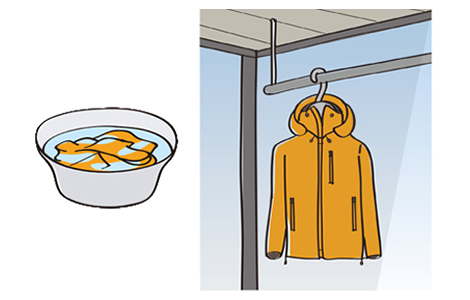
Use a household liquid synthetic detergent in a quantity slightly less than the recommended amount. Once rinsing is complete, drain off the water and hang to dry in the shade. Ensure the garment is completely dry.
* Do not use fabric softener, fragrance additives or bleach.
* As residual detergent can reduce water repellency, please rinse thoroughly.
<WHAT is waterproofing? What is water-repellency?>
‘Water-repellent treatment’ refers to a process that causes the fabric surface to repel water. This is mainly achieved by using a chemical agent (water-repellent agent) to create protrusions on the fabric surface—known as ‘water-repellent groups’—which repel water (this works on the same principle as the fine hairs on the surface of a lotus leaf that repel water).
On the other hand, ‘waterproofing’ refers to structurally treating the garment to prevent water droplets from penetrating the fabric. This is achieved by bonding a waterproof film to the reverse side of the fabric or applying seam tape to the seams to prevent water ingress, thereby keeping the inside of the garment dry.
<DECLINE in Water-Repellency>
Water-repellent treatments degrade as the surface molecules (hydrophobic groups) are knocked down by friction or dirt, making it harder for the fabric to repel water.
Drying the garment thoroughly after washing allows the water-repellent groups to realign, restoring the water-repellent performance and reversing the deterioration.
(However, if the water-repellent agent itself has been worn away due to external damage such as friction, washing and drying alone will not restore the water-repellent performance. In such cases, we recommend applying a water-repellent spray.)
<AGE-related deterioration (water seepage)>
The main causes are thought to be the deterioration of the breathable waterproof film and the seam tape. Breathable waterproof films containing polyurethane gradually deteriorate (hydrolyse) due to UV light and moisture, resulting in ‘water leakage’ where water passes through the fabric.
Generally, the lifespan of polyurethane-based films is said to be 2–3 years on average; however, the rate of deterioration accelerates if the garment is stored whilst still wet after a fishing trip, or if it suffers damage from abrasion.
On the other hand, GORE-TEX breathable waterproof films, which do not contain polyurethane, do not suffer from the deterioration described above; their lifespan is said to be virtually indefinite, and they are renowned for their durability.
<STORAGE Methods>
The smaller you fold the garment, the more likely it is to suffer damage from creasing; furthermore, storing it in a chest of drawers can trap moisture, which accelerates hydrolysis.
The key to making your garment last is to gently wash away any dirt after wearing, air-dry it in the shade, and once dry, hang it on a hanger in a place where moisture is unlikely to accumulate, such as a wardrobe.
Frequently Asked Questions
To what extent can the garments be repaired?
We can repair fabric tears, frayed lines, fasteners and press studs, as well as provide dry cleaning and re-water-repellent treatments.
Please see the After-Sales Service page below.
How should I store rainwear and winter clothing?
1. Please avoid storing items in hot and humid conditions, such as in a car boot.
2. Please do not store the garments as they are after use (i.e. whilst they are still dirty or wet).
3. We recommend storing the items in a well-ventilated place, away from direct sunlight.
4. Please avoid storing the items for long periods whilst folded into small sections, as this can cause the creases to deteriorate.
Please tell me how to care for polarised sunglasses.
1. When cleaning the lenses, hold the outer surface of the lens you are wiping. Wiping with excessive force may cause the frame to lose its shape or lead to breakage due to material deterioration. Rubbing the lenses with anything other than the lens cleaning cloth provided may cause scratches or the surface coating to peel off.
2. After use, wipe off any moisture with the dedicated cleaning cloth supplied with the product, and allow the glasses to dry thoroughly in a well-ventilated, shaded area before storing them. Storing them whilst wet may reduce their polarised function or damage the lenses. After use, ensure they are completely dry and store them in a dry place. If the dedicated cloth becomes dirty, please wash it with water or similar to keep it clean.
Can the auto-inflating cartridge be replaced?
You will need to contact your local fishing tackle shop to order replacement parts or arrange for a manufacturer’s repair. Replacement is recommended every one to three years.